
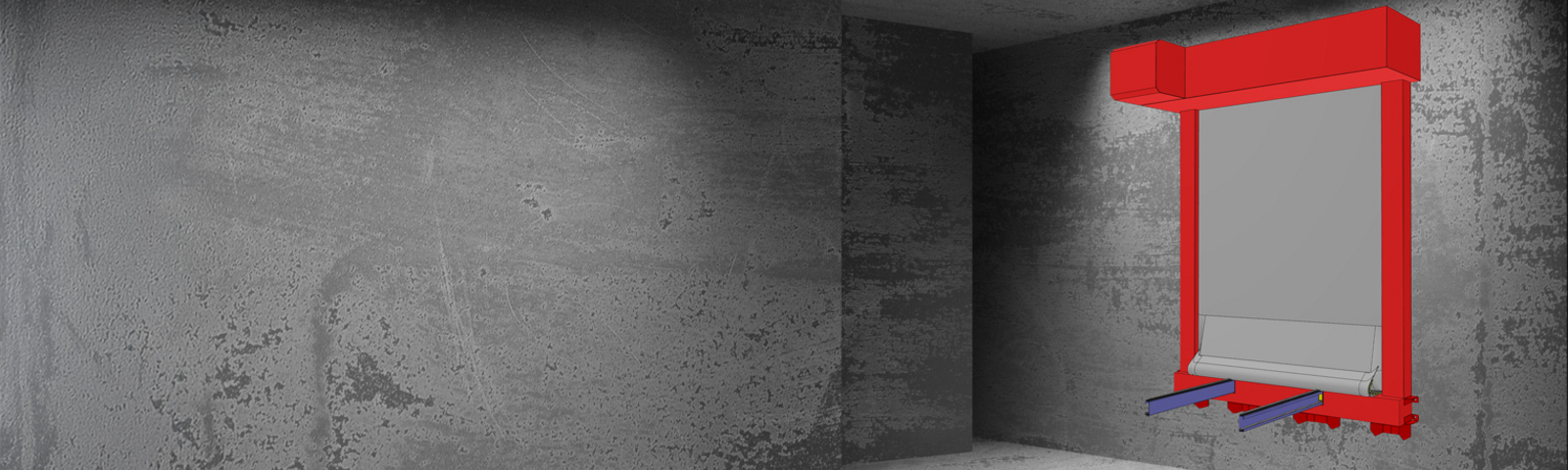
The world's first conveyor belt closure
With the ECClos®-Flex-I, STÖBICH combines decades of expertise in textile fire protection with the field of application of conveyor system closures, in which STÖBICH ➥ pioneered more than 40 years ago.
The ECClos®-Flex-I is currently the 12th world innovation from STÖBICH: as the world's first conveyor system closure of textile construction with a European Technical Assessment (ETA).
What does this approval mean? Where is the ECClos®-Flex-I used, what advantages does it offer and how does it work in detail?
Components and function of the ECClos®-Flex-I
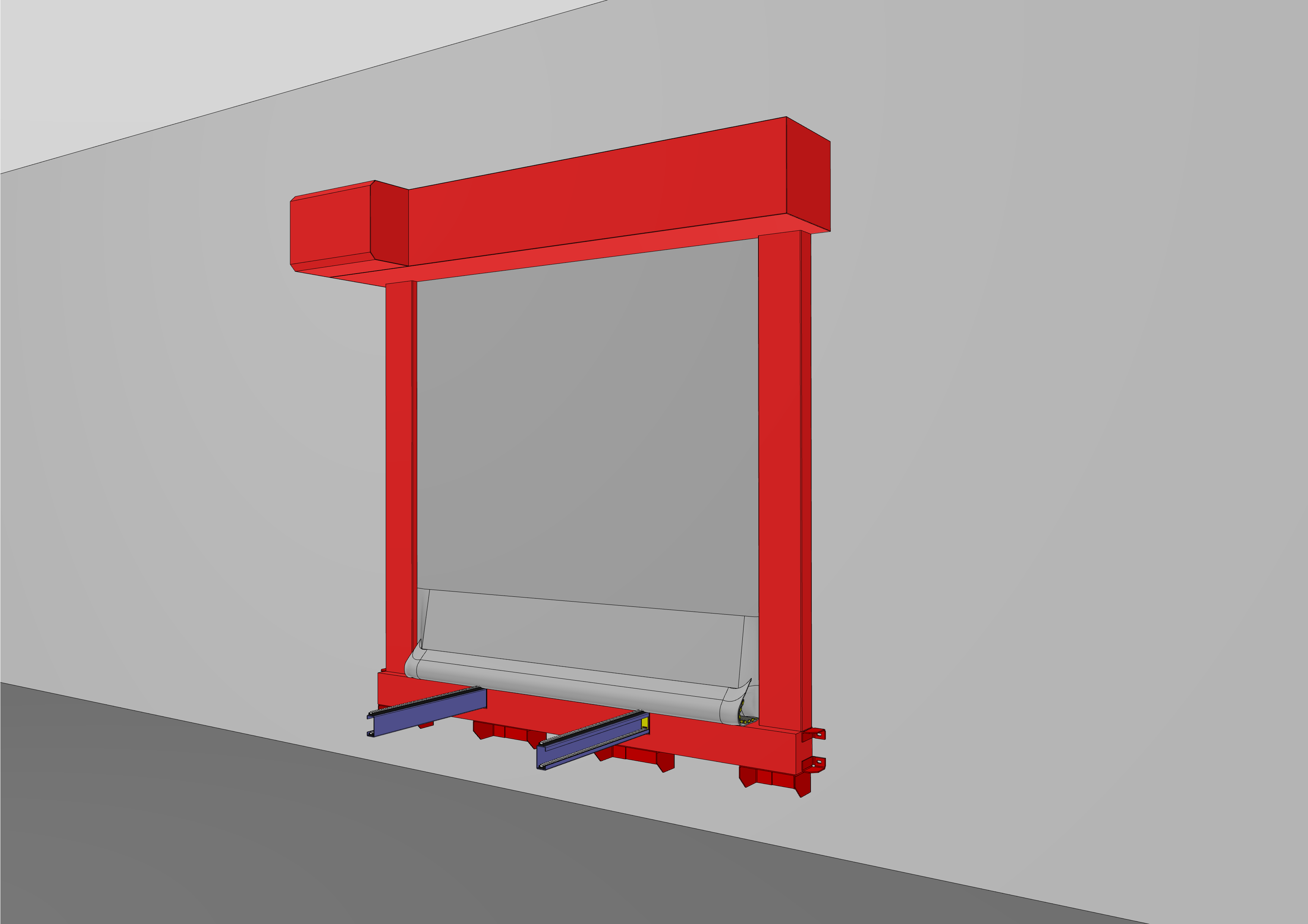
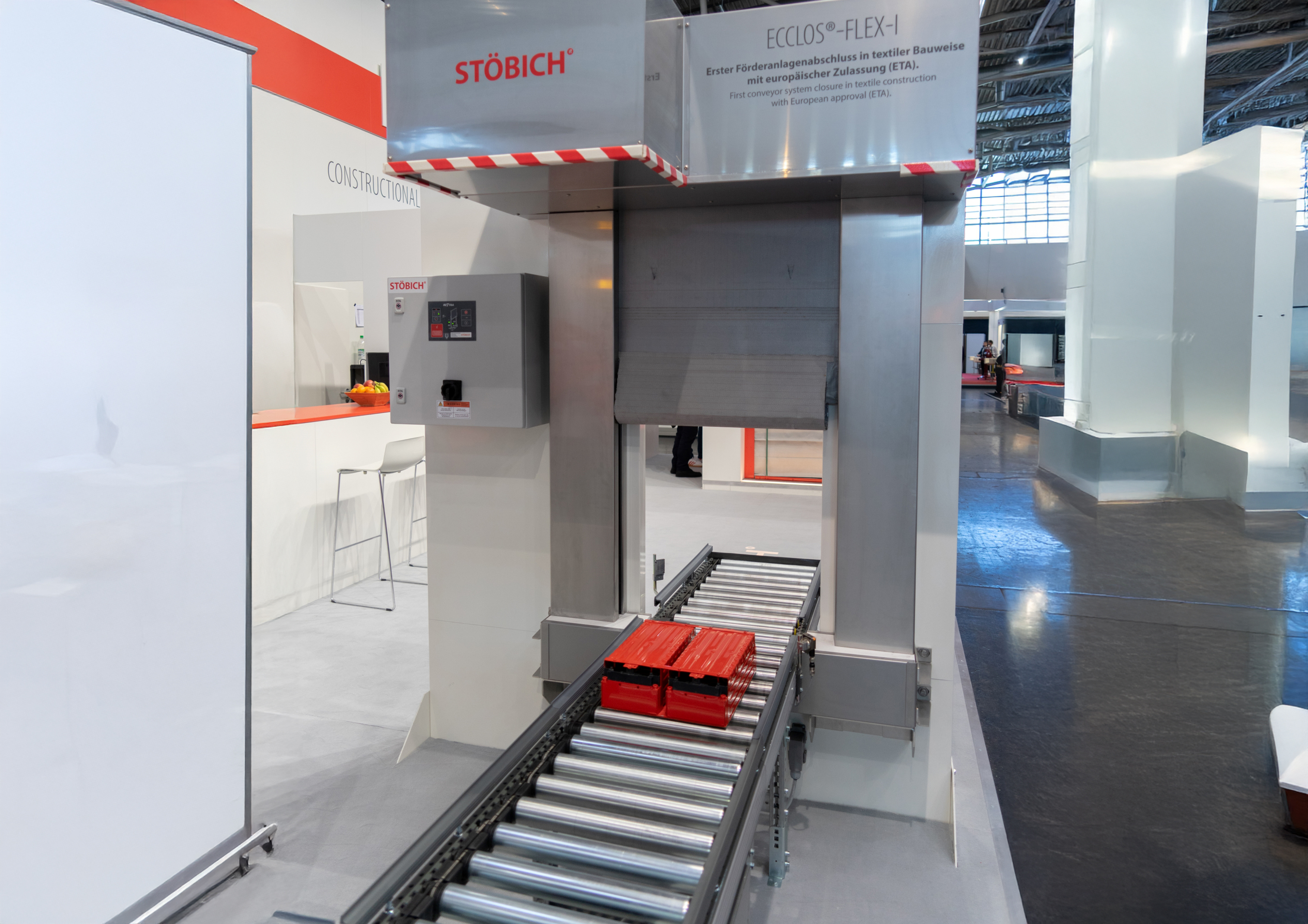
The ECClos®-Flex-I is a conveyor system closure consisting of a movable textile curtain and a fixed panel for enclosing the conveyor system in the closing area. In the event of a fire alarm, the fire protection closure closes the wall opening at a controlled speed by means of gravity-assisted Gravigen technology (self-firing, currentless). It thus segments buildings with intralogistics applications into fire compartments and prevents the uncontrolled spread of fire to adjacent areas. In its basic position, the ECClos®-Flex-I is open as planned and does not interfere with ongoing conveyor operations. It is equipped with an approved hold-open system with a certificate of usability from the building authorities, which releases the closure for closing when the alarm sounds.Heat-insulating textile (sealing surface)
Several layers of different fabric types form a textile curtain that is only a few millimetres thick and is attached to the winding shaft. The individual layers of the curtain contain, among other things, intumescent and endothermic (heat-consuming) materials: in the event of a fire, this composite material acts like a heat shield and the curtain expands when exposed to heat.
Fixed field (adaptation to conveyor system at a higher installation position)
The fixed field is attached to the wall like the fire protection closure, encompasses the conveyor system and can be optionally covered with a steel plate. Intumescent materials fill the necessary functional gaps between the fixed field and conveyor system in the event of a fire.
You can find detailed technical information such as dimensions, system design and the technical data sheet in the ➥ product description..
Vorteile
• Can be used for both separate and continuous conveyor technology
• Minimal space required on all sides due to heat-insulating properties,
- because no space is needed for the valve blade next to or above/below the wall opening (unlike the classic FAA with a valve blade construction)
- because no space is needed for flaps (as is traditionally the case with flap construction)
• Suitable for large wall openings with no space around them
• Space requirement above the wall less than 490 mm, to the side of the wall less than 290 mm for a wall opening of max. 6,000 x 4,400 mm (width x height)
• Defined protection goal: fire resistance class: up to EI2 90 = thermal insulation for up to 90 minutes
APPLICATIONS
Versatile and approved throughout Europe Thanks to its heat-insulating properties, the ECClos®-Flex-I only requires the space of its housing and can be used wherever space is limited, e.g. in logistics centres, where there are many gates next to each other and several trucks dock next to each other for unloading. In the automotive industry, the intralogistics opening must be very large, e.g. for the car body. For walls in panel construction, ECClos®-Flex-I requires only a few mounting points. ECClos®-Flex-I is also suitable for use in passageways to other halls, e.g. for use with industrial trucks.
What does the ETA mean for use?
The conveyor system closure ECClos®-Flex-I may be sold and installed throughout Europe. This makes it the first conveyor system closure of textile construction with a European Technical Assessment.
The testing according to ETA places significantly stricter requirements on conveyor system closures than fire tests for conventional floor-closing fire protection closures and fire protection curtains, in particular for the elevated installation position and the enclosure of continuous conveyor technology. The ETA refers to the ECClos®-Flex-I kit. The control technology is not yet internationally standardised, but must be tested nationally in the respective market.
Quality assurance: built and tested
Like every product that leaves the STÖBICH production, the ECClos®-Flex-I also undergoes a quality assurance process: in the first step, self-monitoring takes place in production. The results of this are incorporated into the external monitoring by an independent materials testing institute. The audit procedure is an essential part of the verification procedure.
European Technical Assessment & DIBt
ETA: European Technical Assessment; German: Europäische Technische Bewertung. The ETA is a product performance certificate that leads to CE marking. It can be used to market products throughout the European Economic Area, Switzerland and Turkey. In many cases, the ETA also opens doors worldwide. An ETA can be applied for any construction product that is not covered, or not fully covered, by a harmonised standard.DIBt: German approval and authorisation body for construction products and types of construction, which grants approvals. It is the Technical Assessment Office that issues the ETA.
More information at ➥ European Technical Assessment (ETA) | DIBt - Deutsches Institut für Bautechnik. There is also an image film here that summarises the tasks of the DIBt.
Discover more ➥ fire protection solutions for conveyor systems and request your personal quote.